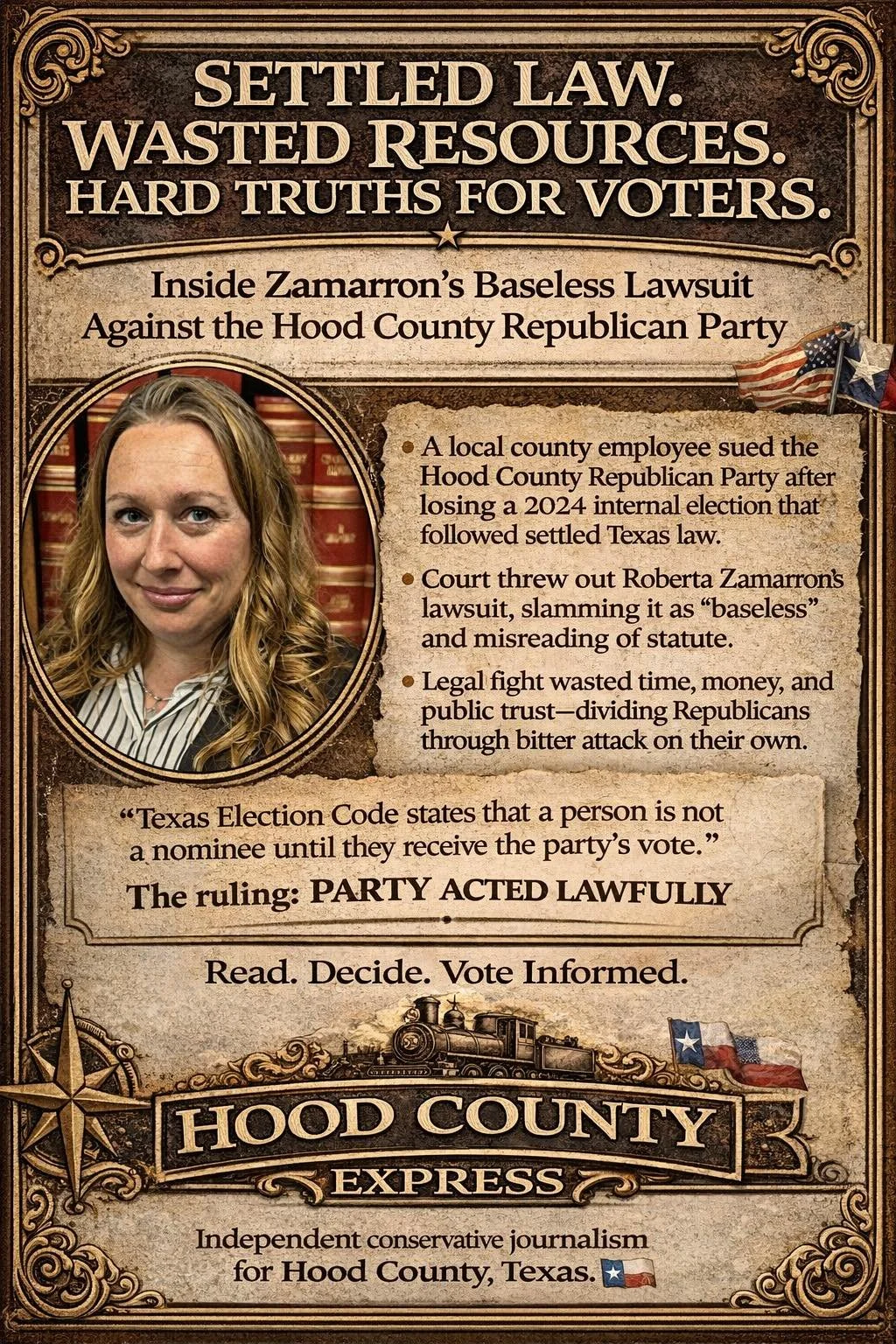
Settled Law, Wasted Resources
Inside Zamarron’s Lawsuit Against the Hood County Republicans
By Hood County Express Investigative Desk
⸻
Last month, we gave readers an “under the hood” look at the County Judge race—one shaping up to be a nail-biter.
This month, we turn our attention to the hotly contested District Clerk’s race, where:
• Incumbent grassroots conservative Melanie Graft is seeking her first full term
• Challenger Roberta Zamarron, a current employee in the County Attorney’s Office, is attempting to unseat her
⸻
As Hood County voters consider this race, an earlier legal dispute involving Zamarron deserves renewed scrutiny—not for political drama, but for what it reveals about:
Judgment
Legal understanding
The real-world consequences of mischaracterizing lawful conduct as wrongdoing
⸻
What Happened in 2024
In 2024, Roberta Zamarron sued the Hood County Republican Party (HCRP), its chairman, the county elections administrator, and fellow Republican Melanie Graft.
This came after Zamarron lost an internal party election that:
• Filled the vacancy created by the death of the prior District Clerk
• Placed Melanie Graft on the November general election ballot as the Republican nominee
A visiting judge from Parker County rejected the lawsuit outright, finding that the Republican Party followed Texas law precisely.
⸻
A review of the court record, statutory authority, and sworn testimony shows the lawsuit was:
Legally unfounded
Harmful to party unity
Damaging to public trust
A drain on limited campaign resources
⸻
What Triggered the Dispute
The controversy began after the death of the sitting Hood County District Clerk during the 2024 election cycle.
When a candidate dies after the filing deadline, Texas law empowers the political party’s executive committee to fill the vacancy for the general election ballot.
FULL STOP. Read that again.
⸻
In June 2024, the HCRP Executive Committee conducted a statutorily authorized internal election, complying with:
• Texas Election Code
• Republican Party of Texas rules
• HCRP bylaws and special rules
• Legal guidance from attorneys and state officials
Melanie Graft was selected as the nominee.
Roberta Zamarron lost—and filed suit.
⸻
Why the Lawsuit Failed
Zamarron alleged the process was improper. At the hearing, defense attorneys explained why the claims failed under settled law.
“Texas Election Code states that a person is not a nominee until they receive the party’s vote. This is a political decision made by the party.”
— Eric Opiela, attorney for the HCRP
“There was no illegal vote.”
— Donna Davidson, attorney for Melanie Graft
The judge agreed.
“You have to follow the law whether you like it or not.”
“I call it like I see it.”
— Visiting Judge Graham Quisenberry
The lawsuit was denied.
Melanie Graft remained on the ballot.
⸻
The Cost of a Baseless Legal Challenge
Even though the lawsuit failed, the consequences were real:
• Financial strain on the HCRP
• Time and energy diverted from voter outreach
• Public confusion created by unfounded allegations
As Graft later noted, weaponizing litigation over internal party decisions risks damaging the broader election process itself.
⸻
Aftermath: Accountability, Not Retaliation
Following the ruling, the HCRP Executive Committee invoked Rule 44 of the Republican Party of Texas to issue a censure resolution addressing the divisive impact of the lawsuit.
Censure is an internal party accountability mechanism, not retaliation.
⸻
The Bottom Line for Voters
The record is clear:
The HCRP followed Texas law
The executive committee acted within statutory authority
The lawsuit failed because it misread settled law
Confusion stemmed from allegations—not illegal conduct
As voters weigh the District Clerk race, this history provides essential context.
⸻
Legal Sidebar — How Texas Law Handled the Vacancy
Texas Election Code §145.036
Allows a party’s county executive committee to fill a vacancy caused by death or ineligibility.
Texas Election Code §145.037
Requires certification of the replacement nominee for the general election ballot.
Texas Election Code §172.058
Ties together vacancy and replacement procedures when a candidate dies after filing.
The law worked exactly as written.
The court enforced it as written.
⸻
Editor’s Comment
The issue boils down to this:
You may not like the law—but the answer is not to sue your own political party. The proper venue for changing laws is Austin, not the courtroom.
Zamarron’s lawsuit was a dirty political stunt, plain and simple.
At Hood County Express, our mission is to cut through the noise and provide facts-based reporting from a fundamentally conservative worldview—and we make no apology for that.